· Nova Machinery Team · Sourcing Guide · 6 min read
Rebar Finishing Cells — Straightener vs Straighten-and-Bend vs Collector vs Hot Take-Up
Choose mill-exit equipment for CRB600H programs — straightener, straighten-and-bend, straight-bar collector, or 300/600 m class hot take-up. Catalog cells ship with a new mill or as upgrades.
Rolling CRB600H bar is only half the plant. The mill-exit cell decides whether you ship coil, straight bar, or stirrups — and how much labor sits at the end of the line. Buyers who specify “a mill with a straightener” without naming the cell type get a machine that does not match the yard.
This guide compares four catalog finishing options from the rolling mill catalog: the CRB600H straightener, the straighten-and-bend cell, the straight-bar collector, and the automatic hot take-up. Each can ship with a new Type 300 or Type 285 line, or as a catalog machine for an existing mill-exit upgrade.
Treat finishing as a cell, not an add-on
A finishing cell has its own foundation, guards, electrics, and infeed/outfeed. It is not a bolt-on that you decide after the mill is grouted. Freeze it with the mill layout, or freeze it as a standalone upgrade with its own bay drawing.
Ask three commercial questions before you pick hardware:
- What does the customer buy? Coil, cut-to-length bar, or bent stirrups.
- Where does the cell sit? Mill-exit (in line with the stands) or independent (fed from stillages or bought-in coil).
- What is already in the shop? A serviceable straightener, a manual bend bench, or nothing.
If the answer to (1) is “all of the above,” you need a mix, not one universal machine. Mixes are normal. They have to be drawn.
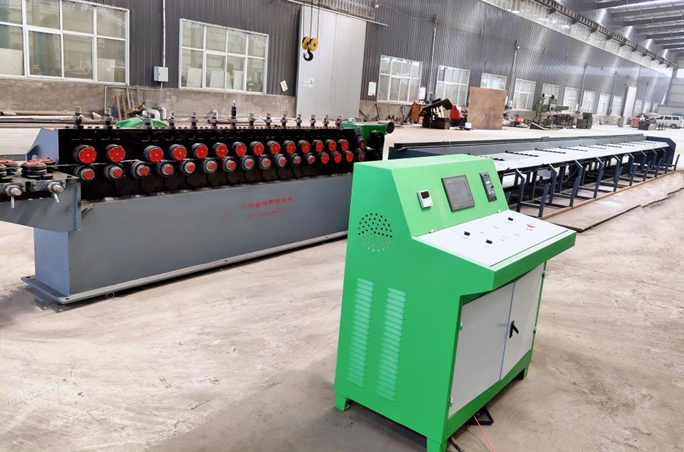
CRB600H straightener
The large CRB600H straightener is the default mill-exit or independent cell when the product is straight bar and you are not automating stirrup bends on the same machine.
Use it when:
- The mill produces φ6–φ12 high-ductility two-ribbed bar that must leave the shop straight, cut, and bundle-ready.
- You already sell coil and want a standalone cell that pays off coil into straight lengths.
- Straightness and cut length are the commercial spec — not bend geometry.
Straightness and cut length are quoted from your bar program. Do not copy a competitor’s cut-length list onto the RFQ unless that list is what you actually sell. Share:
- Diameter mix inside φ6–φ12.
- Cut-length set (stock lengths vs job lengths).
- Straightness expectation in the language your customers use — then we translate that into the offer, rather than inventing a number.
- Whether the cell sits at mill exit or is fed independently.
Spare kits are scoped with the machine. Independent cells still need voltage, infeed, and outfeed on the RFQ, same as a mill-paired cell.
Straighten-and-bend cell
The automatic straighten-and-bend cell is built for construction-steel yards that need stirrups, not only straight lengths. It straightens and then bends in one cell.
Use it when:
- The commercial product is stirrups or bent shapes, not mill-length straight bar alone.
- You want to pair the cell with a new mill or run it as a standalone yard machine fed from coil or mill bar.
- Manual benches are the bottleneck, and the yard will staff an automated cell.
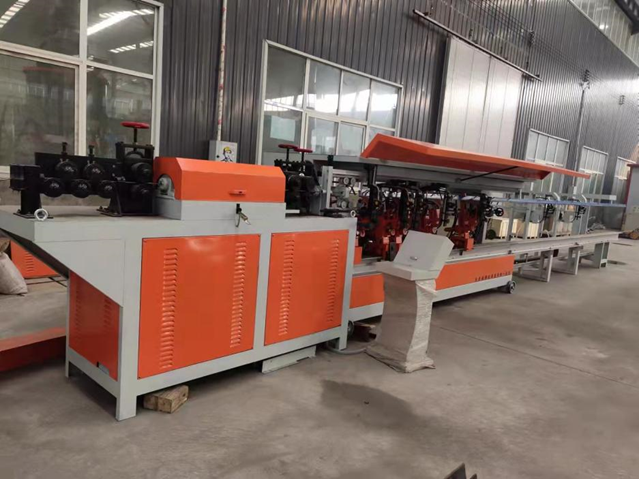
It is not a substitute for mill-exit coiling, and it is not always a substitute for a dedicated straightener. Plants that sell both stock straight bar and stirrups often keep a straightener (or collector + straightener) and a bend cell. Forcing both jobs onto one machine is how changeover time eats the shift.
On the RFQ, describe the stirrup program in plant language: typical shapes, bar diameters, and whether the cell must also drop straight lengths. Do not send a wish list of every possible bend if the yard only runs a handful of shapes.
Straight-bar collector
The intelligent straight-bar collector is mill-exit bundling equipment. It collects and packs straight CRB600H bar so the mill does not terminate in a pile and a crew with hooks.
Use it when:
- The mill runs a straight-bar program and stacking is manual today.
- You want labor off the mill-exit floor without changing the product form to coil.
- Bundles have to match downstream stillages, trucks, or a separate straightener/bend cell.
The collector does not straighten and does not bend. Pair it with the mill and, if needed, with a straightener or bend cell further down the bay. If the product is coil, this is the wrong cell — use hot take-up.
Automatic hot take-up (300 / 600 m class)
The automatic hot take-up is mill-exit coiling in the 300 / 600 m class. It is quoted with a new mill or as a replacement take-up.
Use it when:
- Distributors, mesh lines, or downstream straighteners buy coil.
- You are replacing a worn take-up and want it matched to an existing CRB600H mill.
- Straight-bar collection is not the commercial path.
Confirm coil handling in the plant: crane vs forklift, stillage size, banding, and how coil moves to storage. A take-up that makes a coil the warehouse cannot lift is a layout failure, not a mill success.
Side-by-side choice
| Cell | Product form | Typical position | Pair with |
|---|---|---|---|
| CRB600H straightener | Straight, cut bar | Mill-exit or standalone | Mill, collector, or bought-in coil |
| Straighten-and-bend | Stirrups / bent shapes | Mill-paired or yard standalone | Mill or coil payoff |
| Straight-bar collector | Bundled straight bar | Mill-exit | Mill; optional downstream straighten/bend |
| Hot take-up | Coil (300/600 m class) | Mill-exit | New mill or replacement on existing line |
There is no single “best” cell. There is a cell that matches what you invoice.
New mill versus mill-exit upgrade
With a new mill. Draw finishing on the same layout as Type 300 or Type 285. Civil, cable trays, and operator access are cheaper when they are frozen once. See how to spec a CRB600H mill for inlet rod, frame choice, and RFQ contents.
Without a new mill. Straighteners, straighten-and-bend cells, take-up, and collectors are available as catalog machines for mill-exit upgrades. That path is wholesale / catalog machines: standard SKUs, spare kits, quoted by machine. You still send a bay drawing. An upgrade that ignores existing columns, pits, and conveyors is not cheaper; it is late.
Custom mill programs (voltage, HMI language, commissioning, frozen layout) sit on custom OEM. Use that path when the cell is part of a line freeze, not a spare-parts order.
What to send for a finishing-cell quote
Keep the RFQ short and measurable:
- Bar diameters and CRB600H confirmation.
- Product form: coil, straight, stirrup — with the mix if it is not 100% one form.
- Mill-exit or standalone.
- Existing mill make/model if this is an upgrade (photos of the current exit help more than a nameplate guess).
- Cut lengths or stirrup shapes you actually sell.
- Plant voltage and available bay length.
- Whether FAT is attended and which port receives the crates.
MOQ is quoted by machine. Lead time is quoted after the layout (or at least the infeed/outfeed) is clear. Offers go out on working days.
Finishing cells are where CRB600H programs make or lose money on labor. Spec them with the same discipline as the stands. When the product form and bay drawing are ready, request the quote and name the cell — straightener, bend, collector, take-up, or the mix.